Showing posts with label Trees. Show all posts

Monday, 3 December 2018

Mother’s illness led this man to organic, climate smart agriculture


When Ravdeep’s mother first heard that her son is going to take up farming, she was deeply disappointed. Standing in his farm in Punjab’s Pharwahi village in Barnala, Ravdeep remembers with a smile: “She said all the resources and efforts she had put into my education had been in vain.” But she also knew and took pride in the fact that her son could successfully meet the most difficult challenges. Ravdeep proved it was true when farming became his means of livelihood.
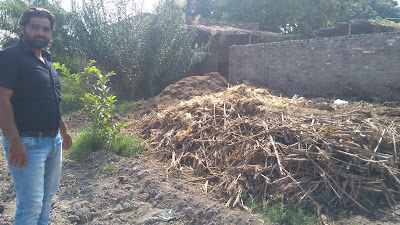

Ravdeep on his farm

Actually, it was because of his mother that Ravdeep had felt an urgent need to grow food organically. When his mother got cancer in 2009, Ravdeep started spending a lot of time at the hospital. The number of people he saw that had got diagnosed with the disease, and the fact that children were also patients, shook him up. He started questioning his entire way of living. “I always knew that chemicals are not good for us but my mother’s illness made me realise that we are poisoning everything . . . our air, water, food.”

Then a friend gave him agriculturist Subhash Palekar’s book on natural farming. Ravdeep also got in touch with Kheti Virasat Mission (KVM), a non-profit working for farmers’ rights and food security that regularly conducts organic farming trainings.

The paddy problem

Ravdeep finally started farming through organic methods in the year 2012. “I first stopped growing paddy. In organic agriculture, it takes longer to harvest. The crop also has to be completely dry or the mandi, the market, does not accept it. By the time this happens, the sowing of the wheat gets delayed. I was also unhappy when I noticed the eventual hardening of the soil due to puddling [when the land is tilled while flooded to make the soil soft for rice plantation].”

Punjab ranks third in rice production in the country with 2.97 million hectares of the land under rice cultivation. 2.5 percent of human induced climate change in the world is estimated to have been contributed by flooded paddy fields.

Ravdeep says, “Earlier at least we used to retain trees around our farms. Now with the overabundance of paddy and the use of tractors and combines, there is no place for trees.” Not only environment but human health has been affected by the overzealous production of paddy. Ravdeep, along with his family, is conscious of his food choices: “Traditionally we grew and ate a variety of crops. Now it’s either rice or wheat and then we struggle with gluten allergy.”

He also blames paddy growing for being the original cause of stubble burning in Punjab, leading to polluting and warming of the atmosphere: “In fact the Punjab Agricultural University, based in Ludhiana, which is now advising farmers against burning, is the one that started doing it years ago.” Farmers say they cannot use machines or labour to remove the stubble because of the expenditure involved. But Ravdeep has a different take. He feels the cost one pays for illnesses like asthma or when injured in an accident caused due to decreased visibility because of smoke is much higher. Farmers need to see economics in its full picture, he insists, and not just have a short term vision.

However, he admits that a good number of farmers cannot afford happy seeders or tractors or other big machines. Some villages have a few of these machines that are to be shared by the community through cooperatives but it is often not practical. Ravdeep explains, “One seeder covers one acre of land per day. Farmers have ten days and 3000 acres to sow. So they need twenty seeders at the same time in the sowing season and cannot afford to take turns individually.”

After all these issues, Punjab has had to face rejection of export consignments because of pesticide residue in the rice. “The farmers who grow this rice do not eat it themselves. It is bought by the Food Corporation of India for distribution. People in south India like their own varieties. So why are we still growing it,” laments Ravdeep.

Beauty, and balance, in diversity

Following farmer-philosopher Masanobu Fukuoka’s book The One-Straw Revolution, on Ravdeep's six-acre farm, he is growing multiple crops, vegetables and fruit and flowering trees. They are not water intensive, and growing them organically has brought back the birds and insects that are killed or driven away by chemicals. In awe of this rich biodiversity through which his farm is making itself climate resilient, Ravdeep confesses that before this he had seen this feature only in the fields of his predecessors. Stubble is “food” for his crops and so he even collects the straw from his neighbours’ fields, which the farmers are only too happy about.


Long lost insects and birds have returned to Ravdeep's farm

The market

Ravdeep, like many other organic farmers, end up selling some of his produce in the common market. Wheat and pulses get the rates deserving of organic produce. He says 5-10 percent of the customers are ready to buy organic food at the correct price, though all agree that chemicals are bad. But in this small percentage there is a mix of “rich, lower middle and middle classes”, explains Ravdeep, depending on how serious they are about their family’s health or whether there has been an illness in the family.

KVM, which Ravdeep is connected with, has a shop in the area but it is open only once a week. Private buyers who get to know of organic farmers also buy from them directly. But Ravdeep says he could not have pulled it off without his family’s support. His wife, who is a teacher, and his daughter help with processing some of the produce at home before it can go to customers. “If I had to go out for processing, the cost and logistics of it would not have worked out.” Therefore Ravdeep recognises that a farmer cannot make a sudden shift to organic farming, and underlines the need for government to incentivise organic agriculture, and to provide markets for those who are already doing it.


First published in Beyond Headlines, 30 Nov.


Friday, 30 November 2018

How these farmers in Punjab are using the practice of mulching to fight climate change


Increasing soil fertility, avoiding stubble burning

Upon reaching Anirudh Vashisht’s farm in Sunam in Sangrur district in Punjab, a couple of other people with a camera could be seen. They had come to document the work of farmers like Vashisht who are setting an example, at a time when Punjab’s farmers have had to bear the brunt of criticism from the capital for stubble burning and adding to air pollution. Vashisht is part of the minority in Punjab that does not burn crop residue.

The documentarians talking to him had primarily come to film instances of stubble burning. To avoid doing it himself, something which leads to pollution, causes accidents by reducing visibility and harms the soil, Vashisht has been practising mulching. In the process, the stubble is cut and collected, and the small pieces are spread over the soil. While explaining the process, Vashisht took a few handfuls of chopped straw and covered the onion and garlic patches with them: “When we burn stubble, we lose microbes healthy for the soil; friendly insects die. Birds and animals also get injured. But with mulching the number of useful microorganisms grows. The soil is protected from the direct sun, its health is preserved and since it is able to retain moisture the ground needs less water. That’s why this process is climate smart.” Chasing away a parrot that had come for the fruit of a tree on the farm, Anirudh gave the example of a forest where grass and leaves cover the soil and it remains fertile despite anyone watering it.

Some farmers who can afford the machine use a rotavator for mechanically spreading the stubble on to the soil but most land owners believe that doing it manually has better results. But isn’t the manual process of mulching labour intensive? “It is,” Vashisht agrees, “but it is a long term investment.” Mulching increases soil fertility and yield and therefore ultimately it would be profitable.

Seema Jolly in Karodan village, Mohali, also prefers to put in human labour in the process of mulching because she does not find the use of big machines consistent with her organic farming practices and principles.

In Barnala’s Pharwahi village, Ravdeep, who is also into organic farming, recalled that even when he was a regular farmer using chemical fertilisers he did not feel comfortable with burning and still used mulching.

For his farm near Kapurthala, Rahul Sharma bought straw from his neighbours to mulch: “Once the soil is covered with the straw, it becomes dark and damp, encouraging the growth of earthworms, which are healthy for soil. If wheat needs to irrigated thrice, then with mulching only two rounds are enough.”

There have come to light other uses for the stubble that comes after a paddy harvest, instead of burning it and adding to climate change. It is being used for power generation, by the paper and packaging industry and, possibly, for furniture.

Why hasn’t mulching become popular in the state yet?

Shamser Singh is a farmer in Sunam. Asked about why he is unable to adopt practices like mulching, he shares: “Machines like happy seeders [machines that cut the straw, sow the next crop and puts the cut stubble over the sown area] and rotavators that should be priced at thousands cost lakhs. How are we supposed to buy them? The 50 percent subsidy is not enough.”
Farmers complained that labour is scarce, especially since many have been absorbed by NREGA (National Rural Employment Guarantee Act) works, and turn out to be expensive for the farmers if employed in huge numbers.

Another farmer, Parpoor Singh, adds, “We also suffer from the effects if stubble burning, from breathing difficulties to burning in the eyes. But what are the options? Let the government subsidise the growing diesel prices so we can use machines to clear the fields of the stubble.”

Time is also a factor. To reduce water use, the government has shifted the rice sowing time further ahead. This means that as soon as farmers harvest paddy, they have to clear the field and sow wheat. In such a scenario, mulching seems time-taking compared to burning the straw. Some farmers also believe that mulching makes the soil uneven and prone to attacks by rodents. But the farmers implementing this practice, including Vashist, saw it more as a prejudice. Buying the straw for commercial use by private parties is not widespread yet.

A few of the residents living around farms said that the pollution around has decreased since the government started imposing a penalty on burning. But this measure could not stop the practice at a larger scale. It led to resentment in the agricultural community against what they see as government’s apathy to their problems.

Farmers across different districts reiterated that they would prefer not to burn the residual straw if the government helps them fight the factors above through cash incentives. Agriculture expert Devinder Sharma agreed, “You cannot remedy this through punitive action. Cash is what the farmers want in the form of an incentive and that is what should be given to them.”

Most farmers using mulching consistently are also those who are doing organic farming and therefore have an overall, larger vision of how agricultural practices should not adversely affect plant, human, animal or environmental health in general. But both organic farmers and experts admit that for the farmers relying heavily on chemicals and under the pressure to get high yields quickly for financial returns, the shift to organic farming, of which mulching is already a part, will also have to be incentivised by the government, especially in the transitional phase.

This article is being published as part of the GIZ-CMS fellowship. First published in DailyO, 30 Nov 2018.


Friday, 15 June 2018

On being wonder-full

My heart leaps up when I behold
A rainbow in the sky;”

That was about William Wordsworth’s heart, which leapt up in 1807. Remember the last time your heart leapt on seeing a rainbow? Or for that matter, even the rain (or the sun, depending on our geography)?

Earlier, as a child, a rainbow was to me a reincarnated fairy from the glossy storybooks my father got from faraway places, spreading out her eastman colour wings. (According to ancient Japanese beliefs, ancestors use the bridge of rainbows to descend on earth.0 But now, courtesy science, first to come to mind are terms like spectrum and vibgyor.

By giving us an insight into nature, science meant to better cement our relationship with nature, to make us an integral part of it. Sadly, though, we repeatedly fail to achieve this, ignoring the many trinkets nature has on display: a toddler’s hysterical giggle (unless offered to us via some viral videos network), an impudent bird on the window sill, a uniquely arched tree . . . We do not have to be Alices in Wonderland to discover all of this. We do need to peek out of our cubbyholes, spare a few moments each day to take in everything beauteous around us that we take for granted in our pursuit of a happiness that is always receding faster than the pace with which we gambol towards it.

Even if the speed of light is slowing down, and even if that might cast an effect on thermodynamics and quantum physics, isn’t it a relief to know that despite climate change the morning sun still softly filters down the hibiscus petals in the lone pot which we forgot to irrigate yesterday in our morning gallop? That moment of standing and staring will probably give us an added incentive to fight climate change, make the battle personal, and so on. Pausing to take in the various elements of nature around us betters concentration and increases our patience.

When life gets infested with the vagaries of this world, I turn to nature for reassurance. The very feeling that I am a part of something so enchanting and true leads to supersonic pain relief. That is why I added this PS when talking to my broker for a new accommodation: “Please see if there is a tree around.”

I look at a tree and think: It took years to grow this tall and now it just stands there, in quiet dignity as so many birds, humans, plants, insects benefit from its presence. Its years are etched as carvings in its bark, a proof of all it endured and embraced, of how it made its own everything that had come to meet it, whether to offer homage or hostility.

A Stanford study found that people who took walks in nature were less likely to be depressed. Ecotherapists recommend spending quality time with nature to fight maladies. If someone still does not have reason enough to turn more animstic, they can turn to Wordsworth again, who believed nature to be “a teacher whose wisdom we can learn, and without which any human life is vain and incomplete”.


First published in Deccan Herald, 28 May 2018.


Powered By Blogger

FOLLOWERS

Blogger last spotted practising feminism, writing, editing, street theatre, aspirational activism.