Showing posts with label War. Show all posts

Wednesday, 13 June 2018

Modern day presidential

Hands,
Hands are crucial.

Hurricane hands
Grabbing pussies,
    beautiful pieces of ass
Building walls
Tearing through gloves,
    insisting on getting themselves dirty
Trashing women cards
Fidgeting around nukes
Ruling the world

Rocking own cradle


First published in Madness Muse Press, 11 Jun 2018.


Wednesday, 21 December 2016

Incomprehension exercise

With Twitter and Facebook
And useless alleys and Jantar Mantar,
Which were benevolently left out of Section 144,
Allowing people the small mercies
Of boasting, roasting, masticating,
Everyone has developed the bad habit
Of having an opinion.

The evening smoke
Rising from the corn on the cob
Wraps your heads in a sensuous aura
And you think you are the bosses-
The bosses on everything
From malnutrition to the moon.

Well, I hate to be the one to break it to you
But you are not experts.

It takes a certain level of expertise
To understand why there is no alternative
Why people must be killed
Why children must be maimed
Why rapes must be committed
Why lawmakers must flout the law.

It takes hard work, blood and sweat,
Erasure of histories and creation of fresh ones under tight deadlines
To develop the nuanced understanding
That with great power comes great arbitrariness.

If those in positions of responsibility
Don't abort the questions brewing in others
They'd be reminded in a flash of their own,
And of memories of others in similar positions

Who tried to be careful custodians of power
And started wondering
Who they were
Responsible for
Accountable to
Whose purpose they were fulfilling
Whose they had pledged to.

They then faced
Sleepless nights, arrests, enquiries,
And the feel of a bullet injected inside their temple with their own hand.

A wise man learns from others' mistakes.
The wise men of today know
That to peer too deep into the sockets of the skull in your hand
Invites the risk of your skull soon being in another hand
They know the only way to keep their head is to bury it in the sand.
But you, all of you worthy of such men's contempt and disgust, you just don't understand.


First published in Indian Cultural Forum, 9 Dec 2016.


Saturday, 17 December 2016

पुराना मुर्गा, नया चोर


पास जब खिलौने नहीं थे,
हम चोर-सिपाही खेलते। 
झूठमूठ की बंदूक से 
कभी तुम मरते, कभी मैं। 

अब सचमुच के हैं तमंचे,
हम अब भी होते दो हिस्से। 
पकड़म-पकड़ाई का अब भी दौर,
बस खेल रहा कोई और। 

First published in Indian Cultural Forum, 9 Dec 2016.


Flawless

Uniforms do not err;
To err is human.

Does superhuman at times include inhuman?

First published in Indian Cultural Forum, 9 Dec 2016.


Thursday, 15 December 2016

Gladiator


On the steps leading to the Betwa river
The boy was selling yesterday's flowers.

My friend had a question for him,
"What do you want to do when you grow up?"

"I'll join the army," was his response.
My friend smiled: "So you want to serve your country."

He continued to hold the water's gaze
At the point where the sun had plopped down and broken into splinters.

"They give you shoes. And clothes.
They take care of everything."


He was planning to live
Unaware that the arena tickets had already been sold.

First published in Indian Cultural Forum, 9 Dec 2016.


Thursday, 26 February 2015

Legacy of a Warrior

Like all legends, Param Vir Chakra awardee Abdul Hamid too had his share of myths around him. A popular one going around was that he had confronted a Pakistani tank with a grenade tied to him in the 1965 war. But when I reached his village Dhamupur (Ghazipur district, Uttar Pradesh) and met his family in nearby town Dullapur, the figure of Abdul Hamid unravelled itself as one of extreme determination, empathy, courage and loyalty. He was not just someone who got acclaim through a solitary heroic act. Absolute surrender to the call of duty, to identify the need of the hour and do exactly that, was a way of life with him.


Abdul Hamid

Not one but two wars

Company Quarter Master Havildar Abdul Hamid was in the 4th Grenadiers of the Indian Army. In the Indo-Sino war of 1962, after having ousted Chinese infiltrators, he lay unconscious for thirteen days and having hoisted the Indian flag on the recaptured land, emerged on the fourteenth day, when the government had almost declared him dead.

Naturally after he came back from the clutches of death, his family grew all the more concerned for his safety. So when he came home in 1965 and got a letter from the headquarters cancelling his leave because of impending war with Pakistan, his family felt apprehensive and asked him not to go. To this, he is said to have replied, 'I have to be loyal to the country that feeds me.' For his family it seemed like a day full of forebodings when the string holding his bedding together gave way, his cycle tyre burst and a black cat crossed his path. He dismissed their superstitions and said once he had stepped out there was no going back. When he reached the station with his father and almost missed the train, his intuition told him something was amiss and he said to his father, 'Do not expect me back.'

That year when he went to join the war Hamid had already served the army for ten years. But neither he nor his fellow soldiers in Khem Karan Sector were prepared for the Pakistani army's Patton tanks advancing towards them. His grandson says the story was reconstructed for the family and others later by a fellow soldier (who lost his hand but was the only one of the team to survive) who was there with his grandfather on the battleground. An old man from the village sympathetically advised Hamid to run away, saying the Indian army wasn't equipped to face the tanks. The friend who survived remembered sharing his anxiety with Hamid, 'Look, their tank says “Allah-hu-Akbar”. Do you think they would really win?' Hamid reassured him, 'But it is us and not them who can see the writing. So it is our victory that is being predicted.' 

Soldiers on the other side also tried to use religion to sway the Indian army, reminding them that they were Mussalmans and should not fight for kafirs. But pledging loyalty to the country they lived in, they fought on. When the soon to get infamous Patton tanks arrived, under heavy firing Abdul Hamid is remembered to have completed the task usually done by three. He drove the vehicle, loaded the recoilless gun and also fired. Constantly changing his position so as not to get exposed to the enemy, he destroyed one tank after another till he suffered a fatal attack launched by the other side. This extraordinary act posthumously brought to him the highest gallantry award-the Param Vir Chakra. Not only that, after Hamid's open challenge to the Patton tanks that ruined their credibility, they were completely withdrawn from subsequent wars.

The wait that wouldn't end

Back in Dhamupur, Abdul Hamid's village, the village head was trying to tune in to the news on the radio. He told Hamid's family that soldiers who had died during the battle were being mentioned in terms of numbers and not names. Another recruit from a village with the same name had also gone for the war, which added to the confusion. An old letter lying at Hamid's house was sought out. The numbers matched and it was confirmed that Hamid had been lost.


The village house where Hamid lived

His son says that he has very faint memories of that time but there was a gathering of ministers at his home. The administration announced a sum of Rs 10,000 for the family and land in Ghazipur. Abdul Hamid's death anniversary is marked every year in Khem Karan setor, Punjab, on 10 September, where the tanks are displayed and scenes from the war are reconstructed to acquaint the public with his singular courage under fire. In the year 2000, a stamp bearing his picture was issued by the government and a television serial featuring Naseeruddin Shah was also produced. Syed Ehsan Ali wrote a book detailing his personal and professional history. 

Where it all began

Hamid's father Usman Farooqi wanted his son to be a khalifa, a chief wrestler like him. And Hamid could wrestle too. But then he was also a swimmer, a sword fighter and a marksman. The villagers testified to the fact that he could not be beaten at any sport. He loved playing with kids just as much. During a flood, with his strong swimming skills he was able to save many lives. The army was not just any job but a dream for him. 


Entrance to the village

To detain him from joining the army, his father arranged for him to be married. Hamid grew restive that he would no longer be able to pursue his aspiration of becoming a soldier. He secretively went to meet the girl chosen for him and said, 'I like you a lot but we can marry only if you do not dissuade me from joining the army.' The girl, later to be his partner, Rasoolan Bibi, answered, 'If you join the army, it will be a matter of pride for me.'

Those who were left behind

Rasoolan Bibi immediately strikes one as a resilient woman who has seen much and still has a lot of endurance left in her. When I try to speak to her, she regretfully says that I will have to get all information from her son and grandson because she does not keep too well these days and that her memory has been failing her. Yet when I do begin to interview the other two, she interjects to ask me, 'Tell me something. We have met so many people and so many have come and written in their books like you do now. Help me understand. When will something come out of all this? There isn't even a hospital in our village yet. The park built in his memory is hardly looked after.' 


Memorial park

Her grandson Jamil Alam, a determined young man employed with the railways, shares his grandmother's hurt that they have had to meet and appeal to so many people for what should have been rightfully theirs. 'If we had been asking just for ourselves, it would have been one thing. But we ask for the village, the community.' Recently after he took up the matter with chief minister Akhilesh Yadav the CM made an announcement for the hospital but after the chief medical officer's survey, they have just been waiting. The other fear is that if the government changes it may not honour the promises made by those who were in power earlier. Jamil admits that his generation did not have to face poverty but this was not the case when Rasoolan Bibi was left alone to fend for her five children after the death of the soldier. 

Her son Juned Alam says, 'In those days, it used to be a monthly pension of Rs 200. After having to fight for it over the years, it has now become a somewhat decent sum.' He says when the government had announced two bighas of land for the martyr's family, the village head had felt it did not suitably honour Hamid's exploits. Then the administration raised it to five bighas, to which the village head added another five, adding that Abdul Hamid had brought honour to the entire village. 'When Ram Vilas Paswan was the railway minister, he had considered naming a train and the nearest railway station after my father,' Juned Alam says. But, he laments, those who fight for their country aren't though of worth much in this country. He appreciated how the minister announced a job for him and a railway pass for his mother even though at that time the election commission had warned against making promising announcements in election constituencies. Turning to me anxiously, he asks, ' Is it possible to edit the book written by Rahi Masoom Raza? It mentions that my father destroyed three tanks when in fact they were seven.' After so many years, reconstructing history is a tough job and oral narratives have to be relied on, or at least heard as they are meant to.

Juned Alam's son and Abdul Hamid's grandson Jamil Alam is a doer like his famed ancestor. He started accompanying his grandmother to public functions and meetings with ministers at the age of fifteen. In Rae Bareilly he was assertive enough to meet with his grandmother Sonia and Rahul Gandhi. When a car was sent for them, he said he did not believe in hiding his identity and went ahead in a rickshaw. Despite chief minister Mayawati's assurances that their petition would be considered, he and Rasoolan Bibi also wanted to meet the then President Pratibha Patil. Upon looking at their demands the President said they could have approached the local MP or MLA for the same. Jamil's reply was, 'You are the most important figure of the country. We would not have come to you if things would have got addressed at that level.' When they met Lalu Yadav during his tenure as railway minister he sanctioned Jamil's job, and recently upon meeting prime minister Narendra Modi he was offered a ticket to contest a parliamentary election. 'I refused; I felt it was too soon.' 

Juned Alam says that wherever his father's memory can be honoured by spending some money, he and his family do that according to what they can afford. They organise an annual function at the memorial park with their own money. He worries, 'The waterproof tent itself costs around Rs 50,000. How much can we do?' Jamil adds that ministers and actors earlier used to be reluctant to come to a village to attend such a programme. But over the years he has worked hard to make it bigger and well known people have started attending. He is grateful to the media for having always being supportive. Three Hindi film directors, along with actors like Salman Khan and John Abraham, have also expressed an interest in Abdul Hamid's story being adapted into a film. While they have promised full support, Jamil hopes that the filmmakers would be able to find enough money to finance the productions. 

Some time back Jamil went to the administration with a plaque in his grandfather's name, requesting it be put in the marketplace. The magistrate said they could not do this without permission. Jamil then met the CM who sanctioned it and Hamid Chowk came into being. The marble stone with Abdul Hamid's name inscribed on it at the Dullapur railway station had weathered away. Jamil got a new one put in place, also replacing the deteriorated marker of another war martyr on the same platform.


Hamid Chowk

The family speaks of an NRI who had come to India from the US especially to attend the annual programme held at Khem Karan. He was greatly touched by Hamid's story and even invited the family to the US, where he wanted to organise something similar. Jamil's cousin Rizwan smiles, 'If our grandfather had been from the US, probably he and his family would have been valued more.' 

Jamil agrees, 'Why would anyone martyr themselves for a cause if they cannot feel reassured that their families would be looked after? Nobody came to see how Dadi was bringing up her children alone. The district has become famous because of my grandfather's deeds. But not enough is done to preserve his memory.' His own little son talks of his great-grandfather's heroic acts like he has witnessed them himself. 


Four generations: Jamil Alam with his grandmother, son and father

Once at a public function Jamil had to interrupt a minister and correct the facts he was relating about Abdul Hamid, much to the minister's chagrin. Then there are times when people try to use Hamid's name to gain leverage themselves. Jamil says that on a TV show Anna Hazare claimed to have been with Hamid in the war. When Jamil asked for details and queried why he had never come to see the family as a friend, he was told by the show host not to ask such questions. Arvind Kejriwal, also on the show, tried to tell him that the issue was corruption. The answer did not satisfy Jamil.

Admitting that he too gets excited upon seeing film actors, he says, 'But people like Dadaji are the real heroes. And I want to follow in his footsteps.' And yet, the family feels, film actors with a Bharat Ratna are accorded more value than a martyr with a Param Vir Chakra. He and his family from time to time organise relief work for the poor. Actor Salman Khan advised Jamil that he too would like to donate once they have a trust. So the family is now about to set up a trust in Abdul Hamid's name, which they can then use to help the community. 

Fragmented memories

While they may get mixed up about the details, many in Ghazipur district do know of Abdul Hamid as an exceptionally brave soldier. My own local taxi driver had been able to share with me a lot of information even before they later got corroborated by the family. Telling me of the bridge and the road named after the martyr, Hamid Setu and Vir Abdul Hamid Marg, Chhotelal Yadav proudly narrates, 'The people of Ghazipur are known to be courageous. They are not afraid of dying on the battlefield. In fact they long for a such a noble death. That is why every year special recruitments are done from this district.'

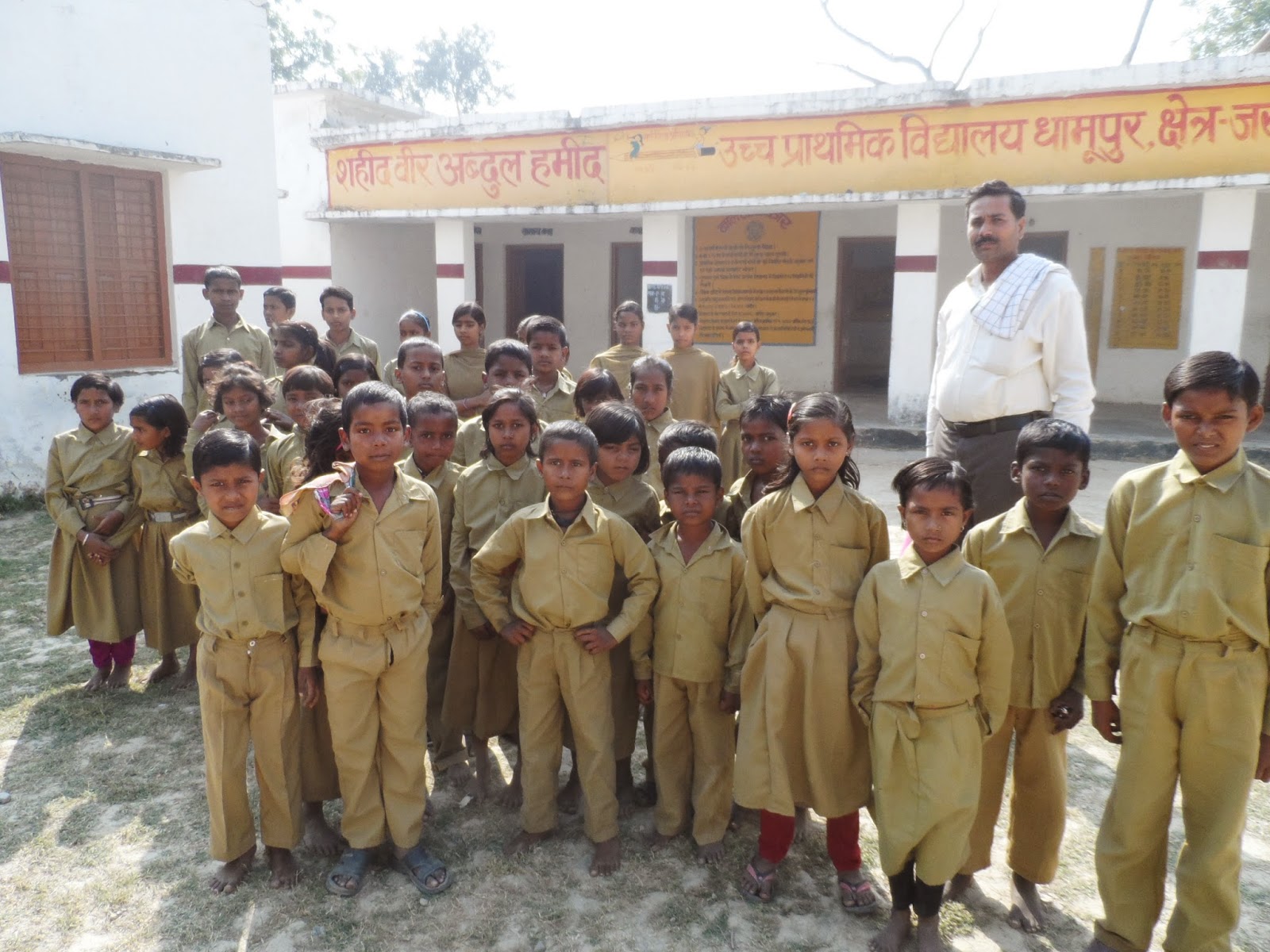
Apart from his wife, not many from Abdul Hamid's generation have survived to tell the tale. In the school named after him in Dhamupur village, I ask the children what they know of him and a little boy tentatively says he was a freedom fighter. An annoyed principal corrects him and tells me that Vir Hamid used to be a part of the textbooks but it was changed with a change in government. Jamil is upset about it and wants to report this to the chief minister. 


Shaheed Vir Abdul Hamid School, Dhamupur

The modern soldier's predicament

To join the army is an individual's choice. But the wars an army fights are those between two political establishments, where the lives of the powers that be are least at stake. Yet for Hamid things were relatively simpler. The 'other', the enemy, lay across the border. Today when under various Special Powers Acts the army is pitted against its 'own' people and is also ordered to keep civilians under fear, when so many army personnel undergo mental trauma and others quit, more than ever the definition of a patriot is in question. What would someone like Abdul Hamid have felt in such a situation?

His grandnephew Rizwan shares, 'The attempt should be to maintain cross-border relations in a way that wars do not happen at all. The money spent on buying weapons can be spent on the country's development. It is good to have security. But what's the use if your country is weak from within?' Jamil agrees, 'Many people like Naxals take up arms because their basic needs are not fulfilled. The inequalities in this country are too steep. Like I was reading the other day, while one person wonders what to eat with so many options about, another has to think of whether there is anything to eat at all.' 

Rasoolan Bibi had to struggle to fend for herself and her children. By the time her grandson's generation came, with education and an awareness of their rights, things had become easier and at present they are financially stable. They have a house in Ghazipur on the land the government gave them and live in Dullapur, close to the native village. A lot of it also had to do with the resolute nature of family members like Jamil who fought to get the family their rights. 


The Dullapur house where the family currently lives

But we know that this is not always the case. Joint families themselves are no longer such a common feature and so the first generation of survivors, especially in rural areas with limited access to education, administration and resources, most in need of support, often fail to get it in time. 

And this when those killed on duty in the army are clearly recognized as having died for the country. Let alone compensation, have we been able to calculate the human cost of war itself - whether when lives are wasted as cannon fodder fighting someone else's war or as collateral damage while contributing to the 'development' that will never reach them?


First published in The Equator Line, January-March 2015.


Wednesday, 23 April 2014

Apathy-Empathy

Leafing through a magazine,
I see the picture of an Afghan
Crying
Beside his dead girl
And feel agonized.

Or, I think I do.

And read on
To find out why
Affleck decided to sign ‘Pearl Harbor’.


First published in HT Ranchi Live, 5 December 2002. 


Monday, 21 April 2014

Who Takes My Salute?

It is easy to play 'spot the evil' when working with mutually understood and long-established signifiers. As a street theatre group, we create many of our productions on an oppressed-versus-oppressor premise and, though struggling to maintain political correctness and avoid stereotypes, we sometimes end up with some sort of a caricature who exhibits a particular inflection of the tone; unrelenting eyes; the cold, even calm, cruelty that comes from the smugness of presupposing the limitlessness of one's aggressive capabilities. In everyday life, putting one's finger on the spot and pointing to what exactly goes into the making of an evil leader is harder. Even harder is to know what crazy salad goes into the making of an Evil Leader.
                                                                     Often we tend to attribute evil in leaders to some kind of madness in them, a psychological condition that makes them a freak of nature. One usually hears the term in context of someone like Hitler. Yet, in Erica Goode's New York Times piece 'Insane or Just Evil? A Psychiatrist Takes a New Look at Hitler' (17 November 1998), psychologist and neurologist Dr Fritz Redlich says that Hitler 'knew what he was doing and he chose to do it with pride and enthusiasm'. Goode summarizes, 'And while the Nazi leader was afflicted with a variety of physical ills, both real and psychogenic, he suffered from nothing severe enough to take the blame for his crimes.' We also know that he was an artist, a kind of person traditionally associated with beauty and gentleness.
                                                                                            Evil cannot be said to be the product of a particular political ideology either. If we have violence of the right wing, including in our own country, we also have leaders like Pol Pot who actually claimed and believed that they were going to make a communist haven through their brutalities. Similarly, in the case of Stalin, it wasn't communism but his blind arrogance, suspicions and attempt to concentrate all power in his hands that sent thousands of people to Siberia to serve undefined terms for indeterminate reasons. Gulags became a metaphor for lives wasted. Of all the brutal killers to emerge from the twentieth century, Lavrenty Beria, the dreaded head of Stalin's secret police, was one of the most malign. 'Show me the man and I'll find you the crime,' he had once remarked. Anton Antonov-Ovseyenko, a historian who spent thirteen years in the camps and later wrote a book about Beria, told the Daily Telegraph of London, 'The gulags existed before Beria, but he was the one who built them on a mass scale. He industrialized the gulag system. Human life had no value for him.'
                                       In India the Aam Aadmi Party rode on a wave of popularity that partly came from the reassurance that the outfit is composed of common people, as underlined in its name, and therefore they would be most sympathetic to the interest of the masses. As citizens, this logic appeals to us and also shakes repetitively ineffectual leaders out of their complacency. However, like international theatre practitioner, academic and author John Britton says, having worked with communities of varying backgrounds, 'I keep hearing politicians talk of ordinary people. I am yet to meet one.' It is a naive assumption to view the entire populace as a common mass with no particularities, the rulers' victims who, once they come into power, would be extremely sensitive to the needs of their fellow beings. Mussolini said in an interview, 'I come of peasant stock. My father was a blacksmith – he gave me strength. And my mother, she was sweet and sensitive – a school teacher – a lover of poetry – she feared my tempestuous nature, but she loved me - and I loved her. Being 'one of the people' did nothing to incline him towards democracy; fascism was his unequivocal choice. 
                                                                              Likewise, in Iraq, Saddam Hussein's extreme poverty of his growing years did not make him the poor people's messiah, though it appeared quite contrary in the beginning. In the nascent years of his leadership, Hussein assumed a clear stance against orthodoxy and worked for the modernization of Iraq. It was under him that the National Campaign for Eradication of Illiteracy and the Campaign for Compulsory Free Education took off. His socialist approach made possible subsidies to farmers, redistribution of land and free hospitalization. He posed a challenge to the West with his nationalization of oil companies. Electricity reached outlying areas. Going beyond primary health care, he brought in advanced and specialized medical advancements and hospitals. Culture, theatre, literature and language were encouraged. Women were declared equal under the law and their liberation seemed the government's goal. Women's partaking of the universal education greatly benefited them and their number amongst the employed started rising. Equal pay and perks could be availed of. A year of maternity leave and public day care centres further facilitated their entry into the paid workforce. They voted and contested elections, and a number of them were elected to the National Assembly. They had the right to own property. This was the Saddam who declared, 'Pay attention to citizens’ demands and grievances and do not feel weary or bored by the persistence of these demands, because if you save a wronged person, partially or totally, you will be doing a great service to the people and the principles of your Party. The sense of injustice is a serious thing. There is nothing more dangerous than a human being who feels he is wronged, because he will turn into a huge explosive force when he feels that no one in the State or in society is on his side to redress the injustice.' In a case of double irony, in the following years he went on to blatantly contradict his own advice and meet the consequences he had warned others against. He became the symbol of repression, war crimes, systematic torture, non-judicial summary killings and ethnic persecution. The sense of injustice in people had indeed become 'a serious thing'; it was almost as if Hussein had provided the ladder to them himself, on which the people were to climb and pull him to the ground.
                                                                          Despite their excesses, many of these statespeople often made what are usually seen as those little kinds of kindness – eating with hutdwellers, accepting flowers from children. But clearly tokenism or even momentary lapses into kindness cannot make up for the countless heads that were made to roll. And therefore we know that in its external manifestation evil does not really come having borrowed the devil's horns and tail.
                                                                  Going through the gory pages of history, one likes to believe that such tragedies were a thing of the past, that with time we naturally start becoming more 'civilized', more humane. But have we really been successful in leaving evil far behind? Have genocides, ethnic cleansing, religious riots, executions stopped? Are we not using our technological advancement to create elaborate instruments of torture? One shudders to admit that these are the very products of our own fantasies and 'vision'. Even the past is kept alive in those of us who extend support to the above-mentioned leaders, who loudly wonder whether they were 'really that bad'. Italy's former prime minister Silvio Berlusconi feels like standing up for Mussolini; in Iran a filmmaker is put under house arrest and banned from pursuing his artistic activities, which, as far as the director is concerned, is the same as banning him from being. 
                                                                                          We brand a man Mahatma and when called upon to practise his teachings, we roll our eyes and plead that he is an 'extra'ordinary creature and, in all fairness and pragmatism, we cannot be expected to emulate him. It is not about whether one likes Gandhi or his opposed to him or worships some other hero. The example is to show what we do when we make someone a hero. We put that person on a pedestal, divorce ourselves from them except to raise our hands in salutation and rescue ourselves from having to follow high ideals and goals. We forget that the hero is an ordinary person trying to do something more. The same psychological pattern is at work when we see one individual as the repository of evil and forget that they weren't born with a dark shadow looming over them. They chose a certain path and were strengthened in their designs by a lot of people, people like us. We should remember that while many were coerced to follow, several others chose to heartily accept such people as their leaders because some of the promises they held out made perfect sense to the 'lunatic', the 'freak', the 'evil' in us – the promise of exclusivity, the reward of being the chosen elect replete with privileges. Then we start supporting leaders who eliminate millions simply because they, with the support of some other millions, can. This is how most people's oppressor became a few people's hero. This darkest face of evil is best portrayed in the film Inglorious Basterds when 'the hunter', adept at sniffing out Jews, gives the matter-of-fact spinechilling statement that they want to end the race simply because they do not like them, just as one dislikes rats. 
                                                             Many of us who may still believe in sound logic also falter when we give in to stereotypes of how a leader should be. We dismiss their repressive policies as a much-needed measure dealt out by a strong hand. It's not much different from how some parents would still believe that a spared rod is tantamount to a spoilt child. Of course we do not acknowledge such manifestation of evil in ourselves till some of us are arrested, our acts finally labelled as crimes, for torturing our children and some, for violating our domestic help. 
                                                                    And when we know this, when we know that evil lives and thrives among us even today, we also have to deal with the fact that we, the 'common people', are also hosts to it. As aam junta, we would never admit that we have anything to do with evil. We would say we have foibles, yes, but we mean well, and we are merely trying to eke out an honest living for ourselves while indulging in the occasional charity. We would be plaintive that if at all, we are at the receiving end: inflation happens, murders and robberies occur in the daylight, and yet we plod on, determined in our struggle. 
                                                        But let us first examine how we often behave in groups, deriving our power – when it has not been officially sanctioned to us – from numbers. Khap panchayats, which hardly compare to the other more formal and organized leaderships, easily order rapes and murders to perpetuate the evil of patriarchy. A protest against rape takes place and some nameless, faceless men make it an opportunity to grope and molest some more, again taking refuge in numbers and blending with the crowds before they can be caught. 
                          If we find ourselves wincing at these associations, let's poof away these crowds and face the looking glass as individuals, many of us, 'decent' folks who may not believe in the authority of khaps or engage in direct violence, still participate in patriarchy from the moment of chalking out our daughter-in-law's functions in her marital space to the time of fixing our daughter's 'age limit' for marriage. Why does a parent and a rapist have the same question to ask of the girl, 'What are you doing outside so late at night?' Why are blackmailers so snug in the knowledge that a woman would choose to succumb to them because otherwise she is sure to be punished, even ostracized, by her own family and community? If we cry out foul that the police is deaf to women's complaints of harassment, why do we shush them up when they report exploitation within the home? Are we going to be outraged at these connections and turn away? Will we be hurt and say these are harsh and cruel labels for pure-hearted souls? Or look ourselves in the eye and decide that we do not just wish and mean well but also do well, not just assume we are pure but are also capable of identifying the impurities that creep in and weeding them out, preparing to understand these connections and disallowing ourselves from cradling evil?
                                                                        Evil grows because of the passivity or paucity of goodness. We have to be as, if not more, firmly assertive and proactive in carrying out 'goodness' in order to give stiff competition to the aggressive directors of operations of evil, or to ruthlessly scrub off the traces of it inside us. It is fitting that the book V for Vendetta by Alan Moore is now being suggested to be made part of prescribed curriculum, in which the protagonist states, 'Since mankind's dawn, a handful of oppressors have accepted the responsibility over our lives that we should have accepted for ourselves. By doing so they took our power. By doing nothing we gave it away.'
                                                                                                                                                                                                                 First published in The Equator Line, April-June 2014.


Wednesday, 15 January 2014

Post-Battle Cries

United we stood,

Until divided by the fall.


First published in DeltaWomen Magazine, 15 December 2013. 


Powered By Blogger

FOLLOWERS

Blogger last spotted practising feminism, writing, editing, street theatre, aspirational activism.